
Mourad Aty[1]Associate Professor – University of Guelma/Algeria; R&D Researcher – CEAUP/ Portugal; CNASPS/ Algeria.
Algeria has always been at the crossroads of civilizations linking Africa, the cradle of humanity, to the Mediterranean and beyond. Its location reflected major geopolitical, economic, and cultural spheres, where different regions, influences, and strategic interests meet. Thus, the country has always been subjected to foreign invasions. Having experienced Roman, Vandal, and Byzantine domination, the nation fostered powerful indigenous Berber states, dynasties, and leaders such as the great Numidian king Jugurtha. The Ottoman presence in the country was seen differently as it was a natural coalition against European powers which posed a threat the country. However, historians like Abulkacem Saadallah who is championed within the Algerian academic circles as an Algerian herodotus, criticized the Ottoman presence, mainly in his books Algeria’s Cultural History (1998) and Research and Opinions on Algeria’s History (1981) were he introduced so many factors which were critical to the decline that led to the French invasion. The latter’s colonization was so brutal and barbaric compared to the other powers’ which tried to control the nation’s territory as the French wanted more. They wanted the minds and the souls.
The brutal colonization of the Algerian territory was attained through genocidal methods to eliminate all types of resistance. The French were the first to introduce the gas chambers while using the “Enfumade” model in committing atrocities against innocent, unarmed civilians in the regions of the Chlef valley, Beni Sebih, El-Oufia, El-Dahra, and Laghouat. Algerians endured all types of colonial repression including forced exile to remote areas such as New Caledonia. The “Code de l’Indéginat” was also another form of repression which gave Algerians a lower judicial status. People in the region of Reggan still suffer from the ramifications of the French nuclear tests. In that particular region, no sign of life can be found even after half a century from the explosions. The May 8th, 1945 Massacres in the regions of Guelma, Setif and Kharrata were the ugliest in the scale of repression, tens of thousands of civilians were assassinated by the military, the police, and the militias which were formed under a close watch of the colonial administration. In my city, Guelma, this wound is still open and revisited yearly during the commemoration of the massacres. Algeria counts 1541 municipalities, there is a martyrs’ cemetery in almost every single one of them. The impact of the French genocidal attitude is enduring and long-lasting, everyone can see it in the cemeteries, in the rituals, and in the faces of the people.
As a descendant of a rebel family, the upbringing was imbued with a great revolutionary legacy that reflected the sacrifices within the immediate sphere. Being born to and raised by a mother who saw her father providing provisions to the Mujahideen within a ramified network which was created to back up the armed action in the mountains, the main concern was to try to understand how humans could be that brutal while proudly championing the sacrifices of the men and women who fought bravely against that particular death machine. This same mother who saw her father being arrested and later on left at the doorstep in blood after many days of torture, tells the story repeatedly and in a way that makes you emotionally and psychologically deal with it as if you hear it for the first time.
On the father’s side, things were different as he himself was subjected to torture at a very young age. Being caught on his way to provide food to the rebels, he was relentlessly tortured. At the age of nine, although he was suffering, the only thing he cared about was his little dog which was shot to death, and from whom he never turned his face. On that same mountain called Mermoura, a famous battle took place where the rebels shot down the Alouette helicopter with Lt. Colonel Pierre Jeanpierre, the pride of the French army, on board. On this same mountain, my father’s uncle was one of the leaders of the four military formations which fought and died bravely in the legendary Meroumra Battle.
Memory is a strong and a very efficient weapon of resistance in Algeria. It is not limited to preserving the past only, but it is committed to protecting the identity of the whole nation and confronting attempts of erasure or domination. Algerians were successful in preserving the collective identity and the historical memory through preventing the past from being forgotten or distorted. The inclusion of the colonial crimes in the school curricula aimed at confronting oblivion, especially when official France tried to glorify its colonial past through the 2005 law. Memory in Algeria became a means of transmitting the spirit of resilience to new generations through literature, songs, museums, martyrs’ cemeteries and all forms of memory that are transformed into symbolic tools of resistance against forgetting. For my generation, all this strengthened political awareness and provided an understanding of colonial atrocities, thus motivated us to resist oblivion.
The recently ratified anti-colonial law aims to recognize French colonialism as a historical crime with legal and moral dimensions, and not merely a colonial phase in history. This law stipulates that the French state is responsible for the violations committed during the colonial rule, including mass killings, forced displacement, destruction, and the systematic plundering of resources. It also enshrines the principle of official recognition of these crimes as a fundamental step towards achieving historical justice and reparations. Furthermore, the law focuses on protecting Algerian national memory from any form of falsification or glorification of colonialism by criminalizing the denial or the justification of its crimes. It also aims to strengthen historical awareness among new generations, consolidate national identity, and open the door to claims for material and moral compensation for the damages caused by colonialism. In this context, colonialism is transformed from a historical event into a legal and political issue linked to justice, memory, and historical accountability.
The French disgraceful conduct in Algeria was very well depicted by a diplomatic memo that I found while doing some routine archival research at the archives of the Portuguese ministry of foreign relations. The memo says “l’esprit colonial français est très médiocre”, which I can safely translate to “the French colonial ethos is very mediocre”. Coming from another colonial power, reading this made me smile, mainly that official Portugal reconciled with its colonial past while France is still mourning some paradise which they thought they would never lose. How can anyone expect you to turn against your own ideals if raised on the revolutionary spirit of a country which was the bastion of freedom fighters. Amilcar Cabral once said “Christians go to the Vatican, Muslims to Mecca, and revolutionaries to Algiers.” Idols like El Emir Abdel-kader, Larbi Ben M’hidi and Djamila Boupacha are eternalized, their vocation enlighten the road of all those who seek freedom, dignity and pride.
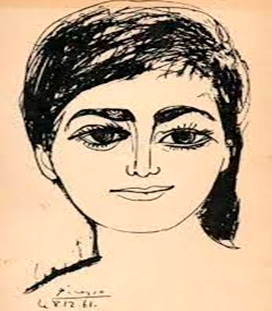
Djamila Boupacha, drawn by Pablo Picasso.
The Spanish painter made a drawing on the eve of the ceasefire (March 1962) in an effort to save Djamila from the guillotine. As an anti-Franco artist, Picasso took an interest in the Algerian Revolution since its outbreak in 1954. The charcoal drawing was featured on the cover of Les Lettres françaises on February 8, 1962, and at the beginning of the legal defense written by Simone de Beauvoir and Gisèle Halimi. It was also on the cover of the book published by Simone de Beauvoir and Gisèle Halimi in 1962.
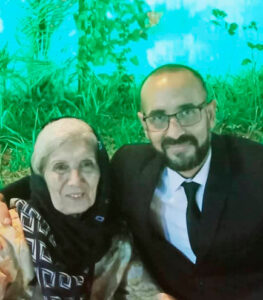
Picture of the author with the icon of the Algerian revolution known worldwide Djamila Boupacha.
| 1 | Associate Professor – University of Guelma/Algeria; R&D Researcher – CEAUP/ Portugal; CNASPS/ Algeria. |
|---|