
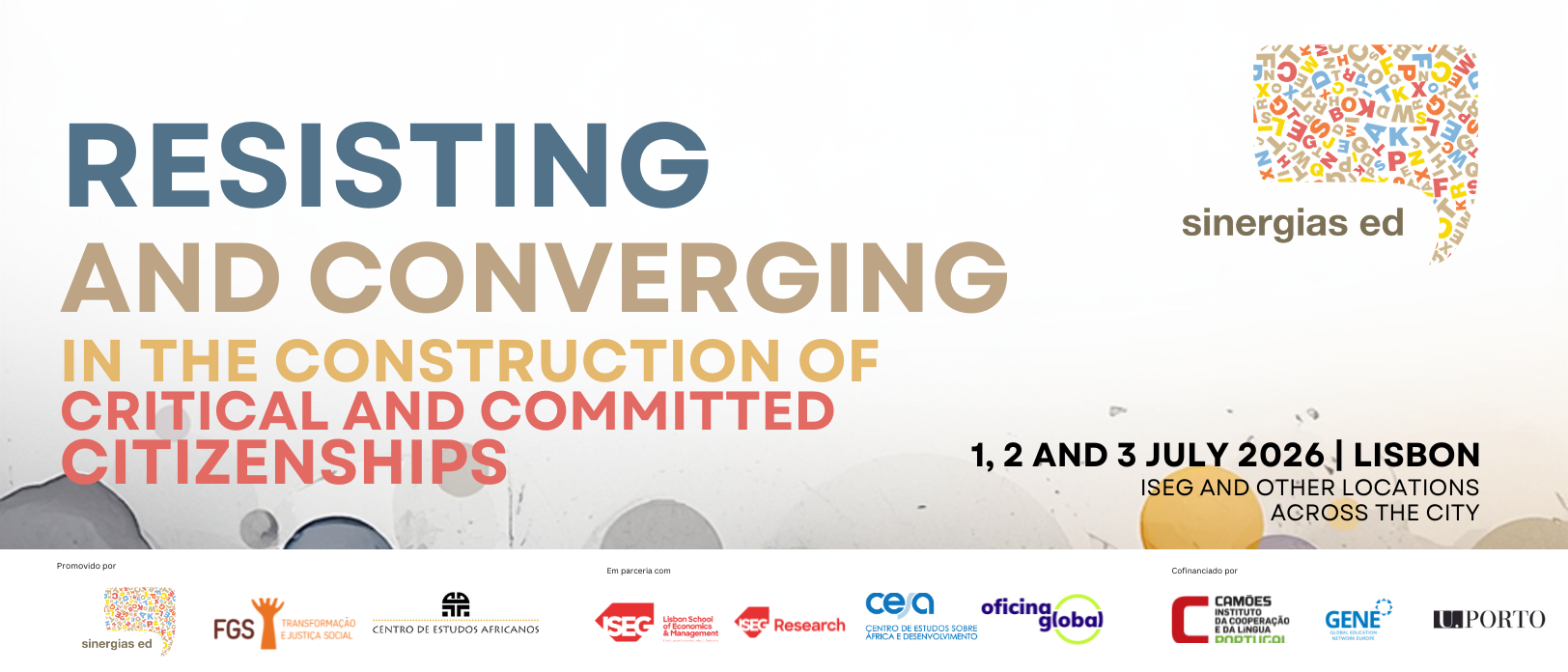
A meeting space for people from academia, civil society, education and political action to share resistances, deepen knowledge and build convergences.
1, 2 and 3 July 2026 – Lisbon
Working languages: Portuguese · Spanish · English
Free participation · Open to all interested people · Registration required.
In a global context marked by growing inequalities, the intensification of systemic violence and the reduction of civic and democratic spaces, the IV International Encounter Synergies for Social Transformation is proposed as a time for sharing resistances, reflection and action in pursuit of convergences, drawing on different educational visions and approaches.
We wish to bring together people who, through education, research and civic action, seek to create opportunities for building, learning and defending critical citizenships committed to social justice. The invitation extends to people from academia, civil society organisations, educators, learners, activists and all those committed to social transformation.
The programme is being built through a participatory approach, with an open call for practices, and aims to question conventional formats of academic gatherings, experimenting with new ways of sharing, producing knowledge and fostering convergences for action.
Registration is open until the 10th of June 2026.
The encounter is structured around underlying generative questions that will help deepen the central theme:
The encounter is grounded in the experimentation of ways of sharing knowledge and practices, inspired by methodologies rooted in collaboration, the ethics of care, ecologies of knowledge, democratic and horizontal power relations, critical thinking and transformative intentionality.
It is structured around three types of methodology:
Moments in which invited speakers bring visions, wisdom and experience to challenge and unsettle us, with space for participation through questions and answers.
An immersive day dedicated to sharing, debating and reflecting on knowledge, practices and experiences of resisting and converging. Each participant brings a practice to share with the group. The groups are facilitated through specific pedagogical proposals and will take place at different locations across the city.
Practical and interactive sessions of approximately 2h30, dedicated to experimentation and the acquisition of knowledge and skills on a specific topic.
15:00 | PARTICIPANT CHECK-IN
| 16:00 | Formal opening of proceedings
|
| 16:30 | Opening Unsettling Dialogue | Where Are We in Building Critical and Engaged Citizenships
Moderator: Sara Borges – Sinergias ED Community and Aga Khan Foundation Portugal |
| 18:00 | Inaugural reception |
| 09:30 | Peer Learning Itineraries | What Are We Doing to Build Critical and Engaged Citizenships Facilitated by:
|
| 17:30 | End of proceedings |
| 20:00 | Community dinner |
Note: Groups are defined based on registrations and submitted practices. Each participant will be informed of their itinerary before the event.
Places are limited to ensure pedagogical quality.
| 09h00 | Start of proceedings |
| 09:30 | Parallel workshops
|
| 12:30 | Lunch |
| 14:00 | Plenary sharing of learnings from the itineraries |
| 14:30 | Closing Unsettling Dialogue | What Knowledge, Alliances and Strategies Do We Need to Build Critical and Engaged Citizenships
Moderator: Susana Constante Pereira, Sinergias ED Community. |
| 16:00 | Closing ceremony
|
The second day of the encounter is built around the practices of resistance and/or convergence brought by participants.
A practice is any form of action, knowledge, learning or behaviour that we activate consciously and intentionally in order to resist and converge in the construction of critical and committed citizenships. Its meaning is deliberately open.
Practices of sustaining and caring for life
Actions, knowledge and expertise that promote resistance and transformation through a logic of care. Bodies, home, neighbourhood, village, the classroom, proximity social networks in everyday life.
Practices that seek to recognise mutual aid, community care, regenerative local practices, relational methodologies, artistic practices, collective memory, and community kitchens as pathways of resistance and convergence in the construction of critical and committed citizenships.
Practices that manifest primarily within the reach of our individual action, associated with our social networks or in our personal, social, professional or civic everyday lives. These practices may be situated in bodies, at home, in the neighbourhood, in the street, in the classroom, in common land, in everyday spaces and contexts, in relationships with family and friends, on an existential level, in the ethical choices we consciously or unconsciously make day to day…
They may include mutual aid initiatives and resource-sharing, community care practices, regenerative responses, eco-social transition and community resource management; pedagogical methodologies centred on relationship and presence; artistic practices, collective memory of a group, community kitchens…
Practices of collective (re)construction of the commons and public space
Actions, knowledge and expertise that promote resistance and transformation through a perspective of collective, organised and awareness-oriented mobilisation.
Campaigns, non-formal education, digital activism, occupation of spaces, artistic productions with political intentionality, alternative communication and counter-narratives…
Organised and structured practices through collectives, groups and projects that manifest in the street, the square, the screen, the stage, in civil society spaces. They require coordination strategies between people and movements, and an intention to deconstruct visions and myths, presenting alternatives, championing social justice, equity and cultural diversity, and defending democracy.
The scale is group or community-based – formal or informal organisations, public, private, or from the social and solidarity economy. They are movements, collectives, associations or activist groups. The strength of this scale lies in the capacity for mobilisation and creating visible critical mass.
They may include awareness campaigns, non-formal education programmes, digital activism and strategic use of social media, occupation and reinterpretation of public spaces, organisation of protest actions, collective artistic productions with political intentionality, popular education and community awareness-raising practices, alternative communication and counter-narrative projects, evidence-based advocacy…
Practices of interconnection and articulation across scales and systems
Actions, knowledge and expertise that promote resistance and transformation at the intersection, articulation and learning between different sectors and systems.
Focus on macro (re)structuring across different systems (economic, social, political, cultural) within societies and on the link between the local and the global.
Systemic perspectives and civilisational alternatives, processes for strengthening civil society, regional and transnational cooperation between movements, co-construction of cross-sectoral public policies, global-scale denunciations…
Practices focused on the macro-level structuring of societies, such as public policies, corporate and institutional policies, and local, national and international governance and participation structures. The scale is that of networks and alliances between organisations, between movements, between territories and countries. Practices that seek to connect the local and the global, link separate movements, and connect critical thinking to strategic action. The strength of this scale lies in the capacity to shape agendas, influence policies and build structurally ambitious alternatives.
They may include knowledge production and research policies, transnational cooperation initiatives between social movements, transnational denunciations, protests or boycotts, migrant integration policies, consultation and co-construction of public policies.
Registration is mandatory and closes on 10 June 2026.
Those wishing to take part in the Peer Learning Itineraries (the immersive day, 2 July) must submit a practice at the time of registration.
Accepted languages: Portuguese, Spanish and English.
This encounter is an initiative of the Sinergias ED project , promoted by the Gonçalo da Silveira Foundation(FGS) and the Centre for African Studies at the University of Porto (CEAUP). In partnership with Global Office, promoted by Centre for African and Development Studies(CEsA) of the Lisbon School of Economics and Management (ISEG), University of Lisbon. Co-funded by Camões, I.P. and Global Education Network Europe (GENE), with the support of the Rectorate of the University of Porto.